
Modeling
Agapito Associates LLC offers numerical modeling techniques that provide a powerful and practical mine design tool to evaluate or compareg mining alternatives before costly experimental mining.
Agapito has the expertise and capabilities to perform stability analysis and simulation of underground mine structures, surface excavations, or solution mining caverns at any point in a mine’s life cycle. Geologic structure, differing rock properties, rock strengths, time-dependent behavior, excavation geometries, linear and non-linear materials, backfill, and ground support elements can be incorporated into the numerical modeling analysis.
Numerical methods employed include finite element, boundary element (displacement discontinuity or fictitious force methods), finite difference, discrete element, and other special purpose codes. For tabular mine layouts, the displacement-discontinuity methods have found wide application in both the two-dimensional (2D) and three-dimensional (3D) forms. Special purpose codes are available to model shaft liner stresses and heat loads, either from emplaced heat sources, such as radioactive waste, or from ventilation cooling.
Modeling experience includes:
- Room-and-pillar stability
- Longwall stability
- Yield pillar behavior
- Longwall shield loading
- Floor heave
- Block caving
- Rock reinforcement
- Subsidence
- Solution cavern stability
- Slope stability
- Nuclear waste emplacement
- Creep closure
- Fluid flow in joints
- Multi-seam mining
- Thermal loading
- Backfill support
- Cavern and well heat loss
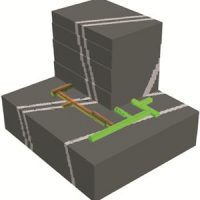
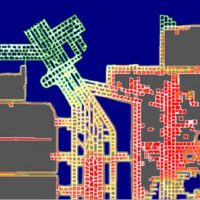
Modeling codes routinely used by AAI include:
| Code | Numerical Method | Capabilities |
|---|---|---|
| FLAC | Finite difference | 2D static, dynamic, creep, fluid flow, and thermal (conductivity) analysis with full spectrum constitutive models for soil and rock |
| FLAC3D | Finite difference | 3D version of FLAC for 3D geometries |
| UDEC | Distinct element | 2D analysis of blocky ground and large deformations |
| PFC3D | Ball code | 3D rock fracturing, caving, and material flow |
| EXPAREA | Boundary element | 2D elasto-plastic analysis of stress and displacement normal to mined seam |
| LAMODEL | Boundary element | 2D elasto-plastic analysis of stress and displacement normal to mined seam with lamination discontinuities |
| Phase2 | Finite element | 2D elasto-plastic finite element stress analysis program for underground or surface excavations in rock or soil |
| SDPS | Influence/profile function | 2D and 3D surface subsidence prediction for underground mining |
| FLAC/Slope | Finite difference | Advanced factor-of-safety determination for rock and soil slopes in 2D |
| SEEP/W | Finite element | 2D groundwater seepage and excess pore-water pressure dissipation analysis in soil and rock |
| KUBRIX | Mesh generator | Automatic all-hexahedral mesh generation software for creating complex 3D model meshes |
| MineSight | 3D block model | 3D geological modeling, mineral resource/reserve estimation, and mine planning |